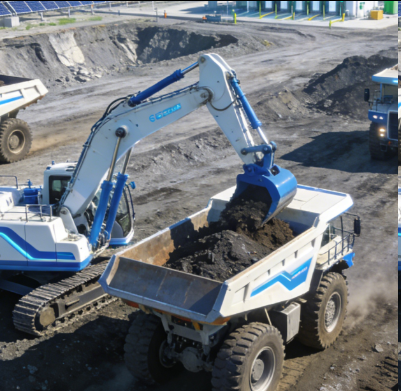
Against the backdrop of global decarbonization and stricter emissions regulations, electric heavy machinery has moved from niche applications to mainstream deployment across construction, mining, and logistics. As of 2026, the sector is defined by rapid technological maturation, shifting regional adoption patterns, and a growing focus on total cost of ownership (TCO). This article examines the latest market data, core technological enablers, and key challenges shaping the transition from diesel to electric power in heavy equipment.
Market Landscape: Segments and Regional Growth
According to 2026 data from the International Energy Agency (IEA) and industry analysts, the global electric heavy machinery market is projected to grow from $18.2 billion in 2026 to $87.4 billion by 2034, representing a compound annual growth rate (CAGR) of 21.7%.
Construction machinery remains the largest segment, accounting for over 62% of the market, driven by demand for electric mini-excavators, wheel loaders, and compactors in urban construction.
Mining equipment is the fastest-growing sub-segment, with a CAGR of 24.3%, fueled by large-scale deployments of electric haul trucks in Australia, Chile, and China.
Geographically, Europe leads in policy-driven adoption:
The European Union’s Stage V emissions standards and carbon border adjustment mechanism (CBAM) have accelerated electric machinery uptake, with Germany, France, and the Nordic countries accounting for over 40% of regional sales.
Asia-Pacific, led by China, is the largest market by volume, supported by government subsidies for new energy construction equipment and domestic manufacturing scale.
North America is a fast-growing adopter, driven by infrastructure investment and corporate sustainability targets in construction and mining.
Core Technological Enablers
The transition to electric heavy machinery is underpinned by three key technological pillars:
High-energy-density batteries: Lithium-iron-phosphate (LFP) and solid-state batteries now deliver 300–500 kWh capacities, enabling 4–8 hours of continuous operation for mid-sized excavators and loaders. Fast-charging infrastructure (15–30 minute top-ups) and battery swapping systems are reducing downtime in mining and logistics.
Integrated powertrain design: Advanced electric motors and inverters improve energy efficiency by 25–30% compared to diesel equivalents, while regenerative braking recovers up to 15% of kinetic energy during operation.
Telematics and fleet management: IoT-enabled monitoring systems track battery health, energy consumption, and equipment utilization, allowing operators to optimize TCO and extend component lifespans.
Despite rapid growth, the sector faces structural barriers:
High upfront costs: Electric heavy machinery typically costs 30–50% more than diesel equivalents, driven by battery and component expenses. While TCO is lower over 5–7 years, upfront investment remains a barrier for small and medium enterprises (SMEs).
Charging infrastructure gaps: Remote mining and construction sites lack reliable power access, limiting deployment of larger electric equipment. Portable charging solutions and on-site renewable energy (solar, wind) are emerging as critical enablers.
Supply chain constraints: Critical minerals (lithium, cobalt, nickel) for batteries are concentrated in a few countries, creating geopolitical and price volatility risks. Manufacturers are increasingly investing in recycled battery materials and local supply chains.
By 2030, electric heavy machinery is expected to account for 25% of global heavy equipment sales, up from 8% in 2026. Key trends will include:
Hybridization: Mild-hybrid and plug-in hybrid systems will bridge the gap for applications where full electrification is not yet feasible.
Autonomous integration: Electric powertrains will be paired with autonomous operation systems, enabling 24/7 operation in mining and logistics.
Circular economy models: Battery leasing, remanufacturing, and second-life applications will reduce TCO and environmental impact.
As the world transitions to net-zero, electric heavy machinery is no longer a future vision—it is a critical component of sustainable industrial operations.